
September 14, 2025
Welcome to Blog #109
This blog is going to chronicle the last few weeks which have been a very unusual adventure. It has been a medical adventure and an adventure I hope not to repeat.
Several weeks ago my afib kicked in and nothing I did would make it get under control.After a day I went to the little Hana Health Center and saw our visiting doctor from Alabama-Dr. Henry Horton Davis . He suggested I should go on into Maui Memorial, but gave me some meds to slow the heart beat down.
But after a day I was still with a fast heart beat.and feeling awful. After my experience at Maui Mem several years ago with my broken arm I didn’t want to go there again. Saturday Morning I bought a one way ticket to Honolulu on Mokulele so I could get to Straub where all my doctors are located. I knew I couldn’t navigate the Kahalui airport with a change of planes and separate airport. The Mokulele flight took 3.5 hours stopping at various places, but seemed like a safer bet. I got Dana to come out and stay and packed my bag. I texted our neighbor, a retired emergency room nurse, who watches the place from up above telling her that I would be leaving for a few days. She texted back immediately, “I am coming down there right now”. So down she came in her brightly colored new golf cart. She took one look at me and said,” Vicky we are calling 911 right now and you have to go to Maui Memorial. I was just there with Walt and it has improved greatly.” So, I agreed and the ambulance was here before we knew it. Since the drive way is still narley she took me to the bottom of the hill to meet the ambulance. They loaded me in, put in an iv and headed out. As we were heading down the road the driver asked if I wanted a 2.5 hour ambulance ride or a helicopter ride. I told him I had never been I a helicopter and that sounded better. By the time we arrived at the Hana Airport the big black helicopter was there with the REACH team all dressed in black jumpsuits with white helmets. VERY impressive to say the least.
They loaded me in laying flat with a medic at my side and said they better give me some meds for air sickness. Up and away we went which made me think of Vietnam and in 15 min we landed at the hospital.

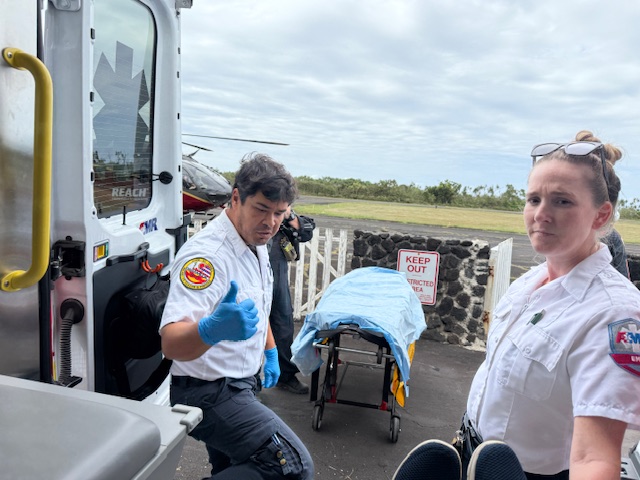

These men took me into the emergancy room where I had a very fine nurse and doctor.
The doctor suggested a procedure called a cardioversion where they shock the heart back to normal rhythm.
I had that, spent the night and ushered to the airport and caught Mokulele Air back home.
For the last five months I have been on schedule to have a Watchman Procedure so I can get off blood thinners. The Watchman seals off the little appendage off the heart where the blood clots form. Last Saturday I went to Honolulu and met my wing woman Jericho Poppler who flew in from Long Beach to have a mini Waikiki vacation and be with me before the procedure on Monday. We stayed at a lovely hotel right on Waikiki and both had a great rest, nice meals and some swims. We walked over to the Outrigger Canoe Club and ran into our old surfing friend Fred Hemmings.


Now back to the coconuts……I was thrilled to read this article from Civil Beat that discusses the tree of Life-the coconut. It makes me sure we are on the right path here with the coconut gene bank and in years to come how important this will be us and future generations.

Help fund the next 15 years of Civil Beat.
Hawai‘i’s Future Depends On The Coconut Tree
But because of the the coconut rhinoceros beetle, we are watching it die.
September 12, 2025 · 5 min read
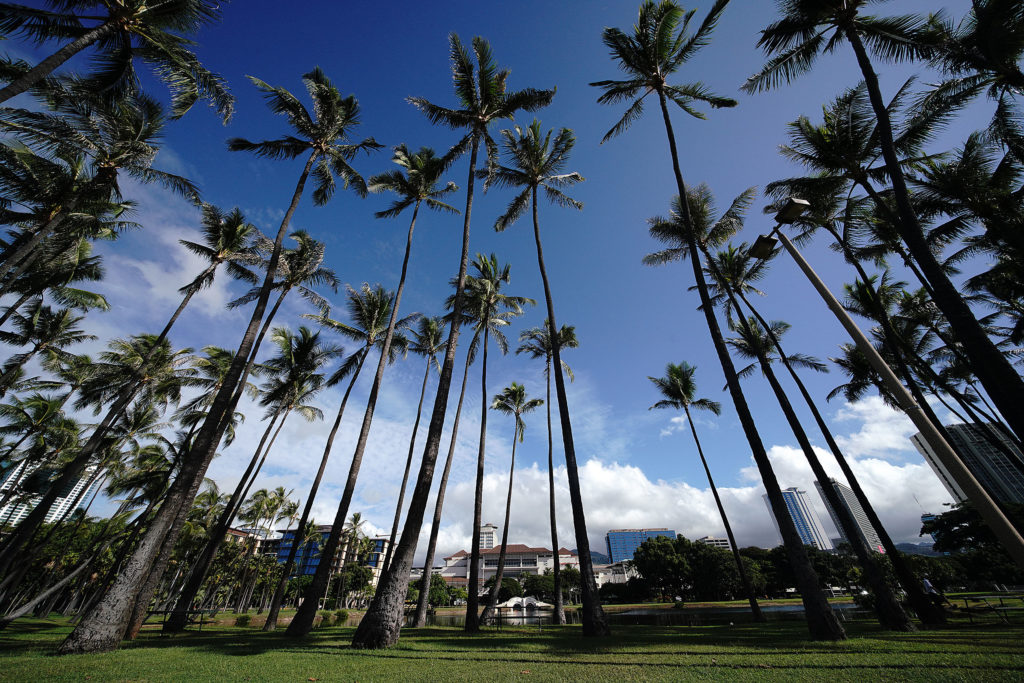
Cory Lum/Civil Beat/2019
About the Author
Kima Wassel Hardy is an urban agroecologist and community organizer based on O‘ahu. She works through cross-sector collaboration to design and implement regenerative agroforestry projects that strengthen local food security and restore ecosystems. With more than a decade of experience in community-based sustainability and cross-cultural facilitation, she is committed to advancing food sovereignty and ecological resilience in Hawai‘i and beyond.
I tried to drop the file without success….
There is no tree more emblematic of Hawai‘i than the niu, the coconut tree. Towering and graceful, its swaying fronds set the scene for postcards and daydreams.

But this tree is more than a backdrop. It is a living relative, a provider, a vital ancestor that helped Polynesians settle these islands. Niu (which is Hawaiian for coconut) is life.
Every part of the tree has value: nourishing water, sustaining meat, shelter from the leaves, medicine from the oil, wood from its trunk and soil stabilization from its roots. In return, all we have to do is care for it.
Today, we are watching it die.
Once cornerstones of food security and cultural identity, niu are now reduced to “ornamental liabilities.”
For over a hundred years, this view has shaped policy and public perception. Resorts and counties lop off fronds and flowers before they can fruit, weakening the tree’s immune system and severing its relationship with our daily lives. After so much time, many people no longer have a personal connection to niu — and without that relationship, it is difficult to expect anyone to care. What appears to be landscaping is, in truth, cultural erasure.
Into this broken system came the coconut rhinoceros beetle, a tenacious pest that has found easy targets in our stressed trees. Rather than respond with care, the state and counties turned to synthetic pesticides — not only ineffective, but harmful to pollinators, soil, and water. Their use violates the principle of mālama ʻāina, which teaches us that the land is family, not a commodity.
Too often, people speak of O‘ahu as if it is already a lost cause to the fight against CRB. But every single tree is worth defending.
We have other tools. Organic methods, tree care, and community-led efforts have shown signs of healing — new fronds growing back, new life pushing forward. Yet the government refuses to acknowledge these practices as legitimate. Instead, it cuts and poisons our trees indiscriminately.
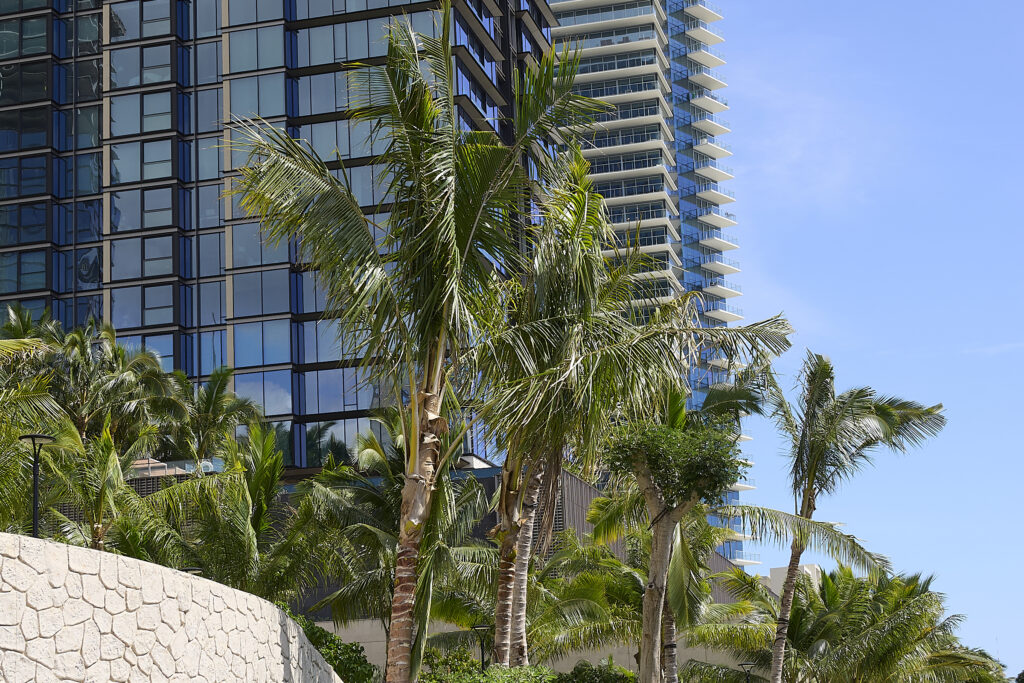
Last year, the state Legislature rejected a bill to recognize niu as a traditional staple crop. Why? Because recognition would require us to honor and protect the tree’s importance as a food source, not dismiss it as mere scenery. That rejection speaks volumes. It’s not just about one tree — it’s about what kind of future we are choosing: resilience or dependence.
Consider this: niu can provide both food and clean water for survival in times of crisis. On an island chain vulnerable to climate shocks, shipping disruptions, and ecological collapse, how can we justify destroying a crop that has fed generations and could be a lifeline in emergencies today?
The threat doesn’t stop with niu: the coconut rhinoceros beetle also attacks other palms, trees, and crops, further undermining the resilience of our landscapes and ecosystems. To deprive our children and grandchildren of this lifeline is to deny them security and abundance. The survival of future generations depends on how we care for niu today. We now face the reality a reality of a Hawai‘i without coconut trees — a future that is unthinkable.
To some, it’s just a tree. To us, it is culture, heritage, and life itself. To lose niu is to lose more than food; it is to erase a living ancestor from Hawai‘i’s future. Its decline is our reckoning — with the land, with our leaders, and with ourselves.
When the coconut tree thrives, so do we.
That is why we are calling on the counties to halt their campaign against coconut trees. We ask them instead to invest in community-led stewardship, support regenerative land management practices, and honor the knowledge that has sustained these islands for centuries. If we truly believe in aloha ʻāina, then our policies must reflect it.
Everything must start with education. Most of those who advocate for niu do so because they have a relationship with it — as food, as shade, as ancestor, as teacher. Facilitating those relationships is vital. Education builds connection, and connection builds care. When more of us know niu not as a liability but as a living relative, more of us will be ready to act — to conserve, to restore, to mālama.
The choices we make now will determine whether future generations inherit a land of abundance, or one of scarcity. The niu has always given freely. It is time for us to give back.
Because when the coconut tree thrives, so do we. Kupu ka niu, kupu ke kanaka. When the coconut grows, humanity flourishes.
For more resources and ways to support community-led stewardship of niu, click here
We have the beginnings of a web site up now, but I am going to be working on this in the coming weeks so hope you will check it out. Koaliniu.org
And, we just had our second donation of $1,000. Which was made by Jericho and will be used for restoration of the ancient lo’i rock walls. Please keep us in mind if you have any extra donation money that you can use for a tax write off.
Several weeks ago our Koali community lost a wonderful member-Anthony James Pu otherwise known as Tony. Tony came up to visit one day several months ago and shared so much valuable information about this property. His passing is a sad loss. I attended his funeral yesterday at the local Catholic Church and what an experience to see how this Hana community revears their kapuna with daily life and ceremonies. What I saw yesterday is a passing important way of life that does not exist anymore. I just feel so lucky to be a witness. I had a nice connection with Tony as he grew up in Nanakuli diving with our friend Buffalo from our old surfing days. He returned to Hana to reclaim his family property and was a lifelong advocate for Hawaiian land and sovereignty.
This has been a long one so am going to close for now.
Hope your week is great and I have more news for next week.
Aloha Nui,
Vicky
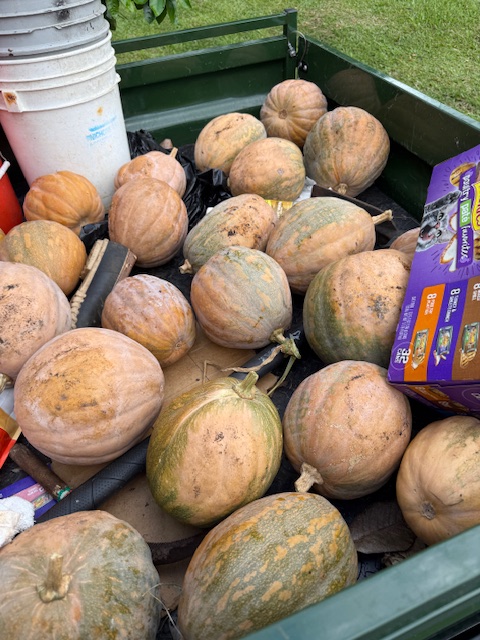
Some of my squash harvest below….
 Wave Woman: The Life and Struggles of a Surfing Pioneer by Vicky Durand
Hi, Vicky.
I’m sorry about your health scare! It’s very impressive and inspiring that, even in the distressing situation that you describe, you continued to be update, notice interesting details around you, take photos, and have fun with friends. This latest adventure will make a great chapter, when you turn your blog into another book. You’re very lucky to have a neighbor who is a retired emergency room nurse. Be sure to stay on great terms with that gem!
With three weeks of the new semester under our belts now, life is starting to calm down a bit. I’ve been swimming once a week at the pool in Coronado with a friend I’ve known since high school. It’s a delicious addition to my daily Pilates routine. And, surprise, surprise: I’ve gotten back to my writing! I hope that you’re proud of me.
I’ll call you one afternoon this week.
Lots of love,
Edith
LikeLike